Dunedin gets properly dark in June. Not dim, not moody – dark, by a little after five, with a long stretch of night still to go before anything useful happens. So a couple of decades back a group of locals decided the sensible response was to build several hundred paper lanterns and walk outside carrying them, and the strange part is that it worked.
Why A City This Far South Invented A Reason To Go Out In June
Doing The Maths On A Dunedin June
We are further south than most people realise. Dunedin sits at about forty-five and a half degrees, which sounds like trivia until the middle of June, when the city gets a shade under nine hours of daylight and a good deal of it is grey. The sun is gone by five. If you work in town you arrive in the dark and leave in the dark, and the harbour turns from silver to black somewhere around afternoon tea.
What that does to a city is predictable enough. Everybody goes home. The Octagon thins out not long after knock-off, the hill suburbs pull their curtains, and the whole place develops a collective hibernation instinct that runs from about May through to August.
Which is the problem the Midwinter Carnival exists to solve, and it solves it by being deliberately unreasonable about it.
Light, Made Rather Than Bought
The premise is simple enough that it sounds naive written down: celebrate the season by bringing light, joy, positivity and togetherness through community participation. That is the carnival’s own wording. What saves it from being a slogan is that the participation part is not decorative – the light at this thing is made by the people who come to it.
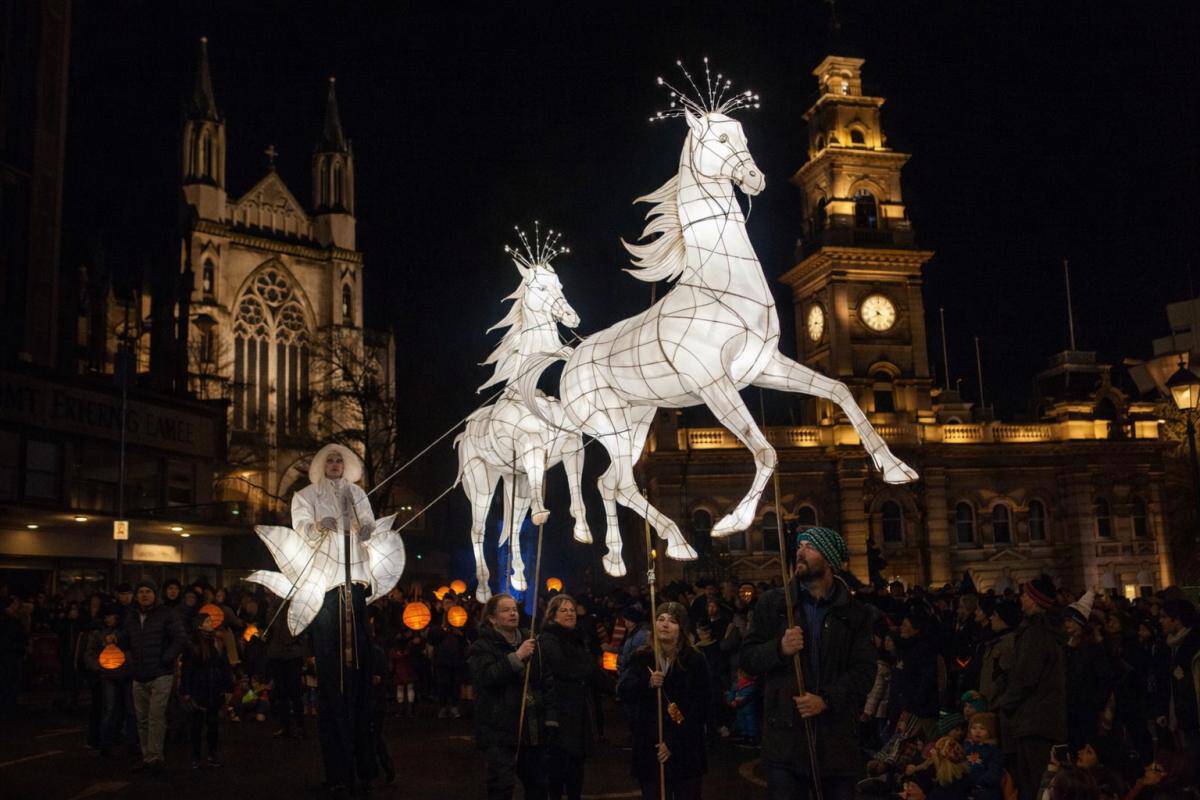
Nobody buys in a display. There is no truckload of festoon lighting arriving from up north. The lanterns that go up are built over the winter by local artists, by volunteers, by school groups, by families who signed up to a workshop and spent a Saturday morning wrestling willow into the rough shape of a bird.
That distinction matters more than it looks. A city can be lit up by a contractor. It can only be lit up by itself once a year.
More Than Twenty Years Of It
The carnival has been doing this in the middle of Dunedin for more than twenty years, which is long enough that it has stopped being an event and started being a season marker. There are people in their late twenties around here who made a lantern at primary school and now bring their own kids to carry one.
That kind of longevity does something to an event’s character. It gets less anxious. It stops trying to prove itself, stops chasing scale, and settles into doing one thing carefully every winter. The theme changes – a rustle in the night one year, an enchanted forest another – but the shape of it does not.
We would call that a very Dunedin way of going about things if we were not worried about sounding pleased with ourselves.
The Months Before The Night
Willow, Tissue Paper, Glue
The making starts long before anyone thinks about tickets. A lantern begins as willow – thin lengths of it, soaked until they bend without snapping, tied off at the joints until a shape appears that is recognisably a bird, or a fish, or something the maker has not entirely decided about yet.
Then comes the skin. Tissue paper, cut into rough panels, pasted over the frame with a glue mix that gets everywhere and dries on your knuckles. It goes on wet and translucent and slightly sad-looking, and then it dries taut, and that is the moment the thing turns from a bundle of sticks into a creature.
The materials cost almost nothing. The time costs everything, which is the entire economics of the carnival in one sentence, and the reason it runs on funding, volunteers and goodwill rather than on the door.
A Hundred And Twenty Hours For One Lantern
The giant lanterns are a different order of undertaking. The carnival reckons each one can take up to 120 hours to build, and those are winter hours – cold ones, in a workshop, at night, put in by people who have day jobs.
They also do not get built once. Every year the big lanterns come back out and have to be repatched into a state that is usable and safe, which is a polite way of saying that paper and Dunedin weather have an ongoing disagreement. The organisers have been moving towards more durable materials to slow that down.
The other shift is money. The carnival has said plainly that it wants to pay its lantern artists properly, and that pushed costs up at the same time as overall funding came down. Handmade is not a marketing word here. It is a wage bill.
The Workshops, And Who Turns Up
The public lantern workshops are where most of the city actually touches this thing. They run in the weeks beforehand, and they are the reason so many Dunedin households have a slightly battered paper moon living in the hall cupboard.
School groups are the engine. Classes come through and make en masse, which is how the children’s parade ends up with hundreds of small lights in it, every one carried by someone who knows exactly which bit they glued. Students turn up too, and community groups, and people who came on their own the first year and now arrive with three mates.
It is worth saying what that room looks like from the inside: trestle tables end to end, wet paper, somebody’s toddler under the table with the offcuts, and forty people who did not know each other in May.
The Longest Night Itself
First Church, Rearranged
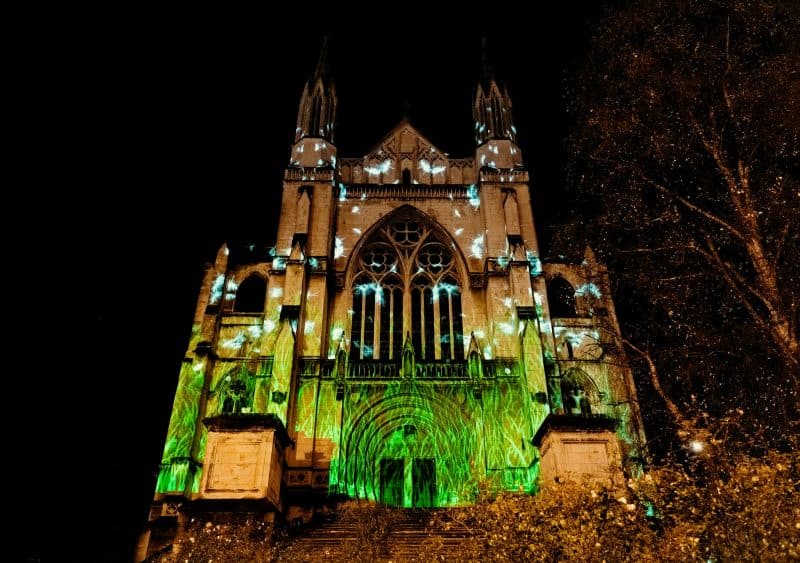
The 2026 carnival happened in and around First Church of Otago on Moray Place – the Gothic spire a block up from the Octagon that most of us drive past without properly looking at.
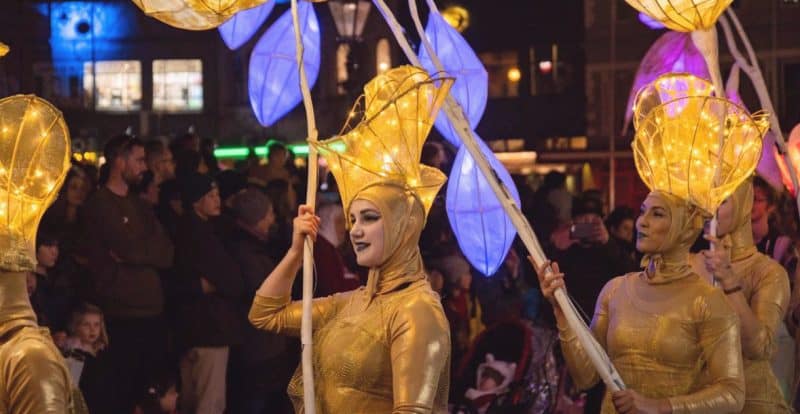
It is a good match, and not only because the building is handsome. The grounds give the carnival a shape: paths to walk, trees to hang things in, dark corners between the lit ones. The lantern processions weave through the grounds rather than down a street, so you move through the thing instead of standing on a kerb watching it go past you.
Inside, the installations go large. Projections across old stone, glowing spaces you walk into rather than look at. A church in the middle of town, filled with paper animals, on the coldest weekend of the year – it ought to feel odd and somehow does not.
Ruru, Tuatara, And A Dragon Or Two
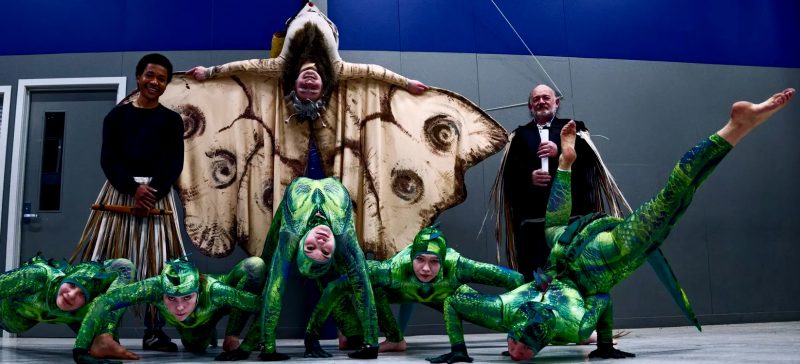
The theme that year was A Rustle in the Night, and the cast list tells you the tone straight away: glowing dragons, watchful ruru, ancient tuatara. Night creatures of the friendly sort. Nobody is trying to frighten anybody.
Above all that, Brophy Aerials worked the trees – aerialists gliding and twirling overhead while you crane your neck and quietly hope the person next to you is craning too. On the ground there was local dance, live music, and a run of food trucks doing what food trucks do best on a June night in Dunedin, which is sell hot things to cold people.
The layering is deliberate. There is always something at eye level, something above your head, and something around the next corner, so nobody stands still long enough to notice the temperature.
Two Sessions, And A Quiet One
It ran across Friday 12 and Saturday 13 June, in two timed sessions each night – one from 5:30 to 7:00pm, the second from 7:30 to 9:00pm, with a short break between them. The same programme ran in both. The point of splitting it is crowding: an hour and a half is enough to walk the whole site properly without shuffling along in a bottleneck.
On the Saturday there was also a low-sensory session from 4:00pm, a calmer version for people who find crowds, noise or sudden light hard work. Sensory ticket holders were welcome to stay on past five if they wanted to.
Postponement dates were held for the following weekend, the 19th and 20th, because this is Dunedin in the middle of winter and pretending otherwise would be optimistic.
The Part That Is Not On The Programme
A Five Dollar Ticket And Why It Exists
The ticket is a relatively recent part of this. Entry in 2026 ran to $5 for children fifteen and under, $10 for adults, or $25 for a family pass covering two adults and two kids, with a booking fee on top. It sold out.
The reasoning has been set out openly by the organisers rather than buried: overall funding has been reduced, costs have gone up, and the lantern-makers deserve to be paid for the work. A modest entry fee introduced a few years back helped, and still does not cover it. One crowdfunding push raised just over $5,000 from 42 donors for the single purpose of paying artists and buying materials for one installation.
Pay-It-Forward sits alongside the ticketing. You can add $5, $10, $20 or $50 when you book, and those tickets go out through partner agencies to the families they work with.
What It Actually Is
Strip the programme away and the Midwinter Carnival is a few thousand people agreeing to be outdoors, in the cold, in the dark, on purpose. That is a stranger achievement than the lanterns are.
What makes it hold together is that nearly everyone there has a hand in it somewhere. The kid carrying the wonky fish made the wonky fish. The woman on the gate spent four Saturdays in a workshop with a glue pot. The dragon overhead took somebody the better part of three working weeks.
You cannot manufacture that. A funder can pay for it, a church can host it, a crowd can turn up for it, but the thing itself only exists because a lot of people in one small city were willing to spend their winter making light out of sticks and paper.
The shortest night is a fact of geography we have no say in. What we do have a say in is whether it passes with the curtains shut. Somewhere in Dunedin right now there is a half-finished ruru sitting in a garage, waiting for next June.